
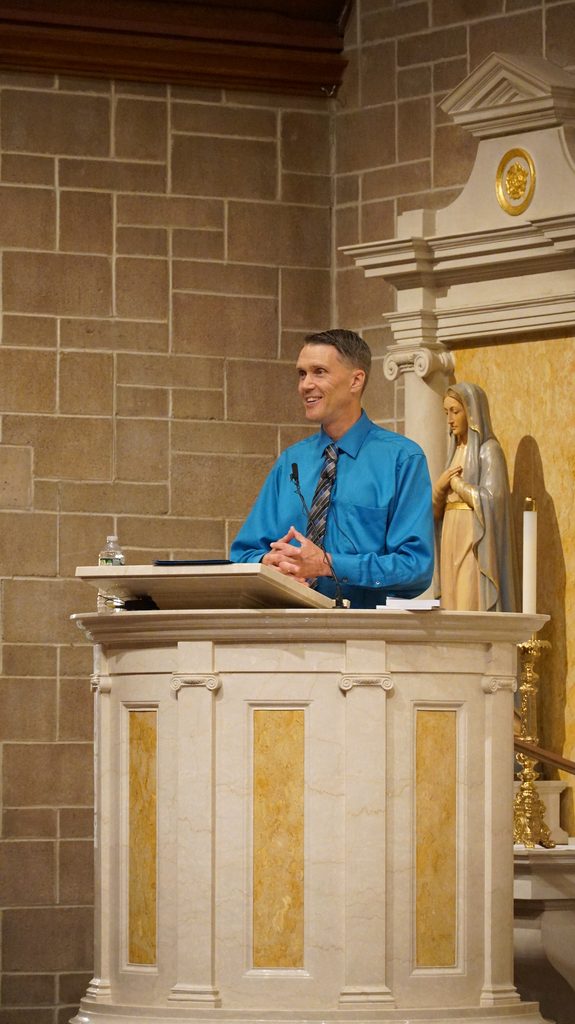
The secret to bringing lapsed Catholics home: “It’s all about love”
Story by Emily Clark Photo by Kate Gombos As a teenager, Bryan Mercier was filled…
Apologetics is the art of explaining and defending the faith. This practice began with St. Peter's blessing in 1 Peter 3:14-16 and continues to this very day.
The aim of apologetics is to engage with life's deepest questions and to enrichen the intellectual life of believers in Jesus Christ. Does God exist? Why does the Church teach this or that? These are the kinds of questions that apologetics considers.
As the Director of Apologetics, I see myself as responsible for three main tasks: teaching Catholic apologetics, organizing opportunities to encounter the Truth, and accompanying people through their questions.
The first task is obvious: teaching the faith (what), reasons for belief (why), and how to communicate the Truth with grace (how).
The second task (organizing opportunities) is detailed in the second (“Services”) section. I see these events as opportunities to encounter Christ in keeping with the vision of The One.
The third task, accompaniment, captures my approach: I want to be present and accessible to the people I am serving.
I will briefly articulate in this section my vision of apologetics and some general goals that I hope to accomplish in the Diocese.
First, although apologetics is usually understood as defending the faith, which has merit as a definition, it runs the risk of creating combative and defensive believers. In order to avoid this problem, I believe apologetics must be connected to a larger notion of intellectual formation. By “intellectual formation” I mean the acquisition of intellectual virtues or habits that are conducive to hearing the voice of Truth. This more holistic approach will help people deepen their knowledge of and intimacy with Christ and so competently engage our ever-changing world.
The main virtues I would like to impart are summarized in the acronym F.I.R.E. I have chosen this acronym due to my awareness of the strengths and limits of apologetics; just as fire can be positive but also destructive, the same is true of apologetics.
Second, my goal is to communicate to Catholics in the Diocese what the Churches teaches, why she teaches what she does (which I consider the essence of apologetics), and how to live out and communicate the truths of Catholicism. It is crucial that Catholics learn to be conversational about their faith and thoughtfully reflect upon why they are believers.
St. Peter writes in 1 Peter 3:15, “But sanctify Christ as Lord in your hearts, always being ready to make a defense (ἀπολογίαν; apologian) to everyone who asks you to give an account for the hope that is in you, but with gentleness and respect.”
The first Pope exhorts us to always be ready, meaning he assumes that followers of Christ are thinking about their reasons for belief and are prepared to give an account of the hope within them. Before we can engage with our secular culture and truly transform it, we must first ensure our own house is in order.
I hope to create a culture of thoughtfulness in this Diocese, where believers can see how apologetics can deepen a relationship with Jesus Christ, the One Who is Truth, and where even those who are no longer Catholic or are not Catholic can be given sincere answers to their deepest questions.
I will share in this section the services that I intend to offer the Diocese as a whole and to the two main audiences that the bishop has assigned to me, parishes and high school juniors and seniors.
Diocese: Catholics in the Diocese will be intellectually stimulated by and with the Catholic tradition, closer to one another and humanity, and prepared to share the Faith “with gentleness and respect” (1 Peter 3:15).
I will share in this section the services that I intend to offer the Diocese as a whole and to the two main audiences that the bishop has assigned to me, parishes and high school juniors and seniors.
Parishes: Rather than adding to a pastor’s workload, my intention is to assist in his mission to feed and inspire Christ’s flock with apologetics and sincere interactions.
I will share in this section the services that I intend to offer the Diocese as a whole and to the two main audiences that the bishop has assigned to me, parishes and high school juniors and seniors.
My goal is to help them see that Catholicism is relevant to their lives and to demonstrate how to practice the faith in a way that is fulfilling and worthwhile.
I think it is best to offer a broad rather than artificially precise plan.
One effective way to introduce myself to parishes is to use the “Donut Sundays” as that introduction. However, given the Stipend Schedule and related costs, we should carefully plan these events
Story by Emily Clark Photo by Kate Gombos As a teenager, Bryan Mercier was filled…
What is apologetics? Why is it important? These are really deep questions… which Bishop Caggiano…
Suan Sonna is excited to announce that apologetics—the reasoned defense and explanation of the Catholic…

St. Matthew Church
216 Scribner Ave, Norwalk, CT 06854
Suan Sonna is the Director of Apologetics for the Diocese of Bridgeport. Suan has a B.A. in Philosophy from Kansas State University, an M.T.S. in New Testament studies from Harvard Divinity School, and is currently pursuing an M.A.R. in Second Temple Judaism at Yale Divinity School.
Suan has appeared on various podcasts and YouTube channels, including Catholic Answers, Counsel of Trent, Pints with Aquinas, and many others. Suan is a Protestant convert to Catholicism.
Contact
[email protected]
(203) 416-1622

