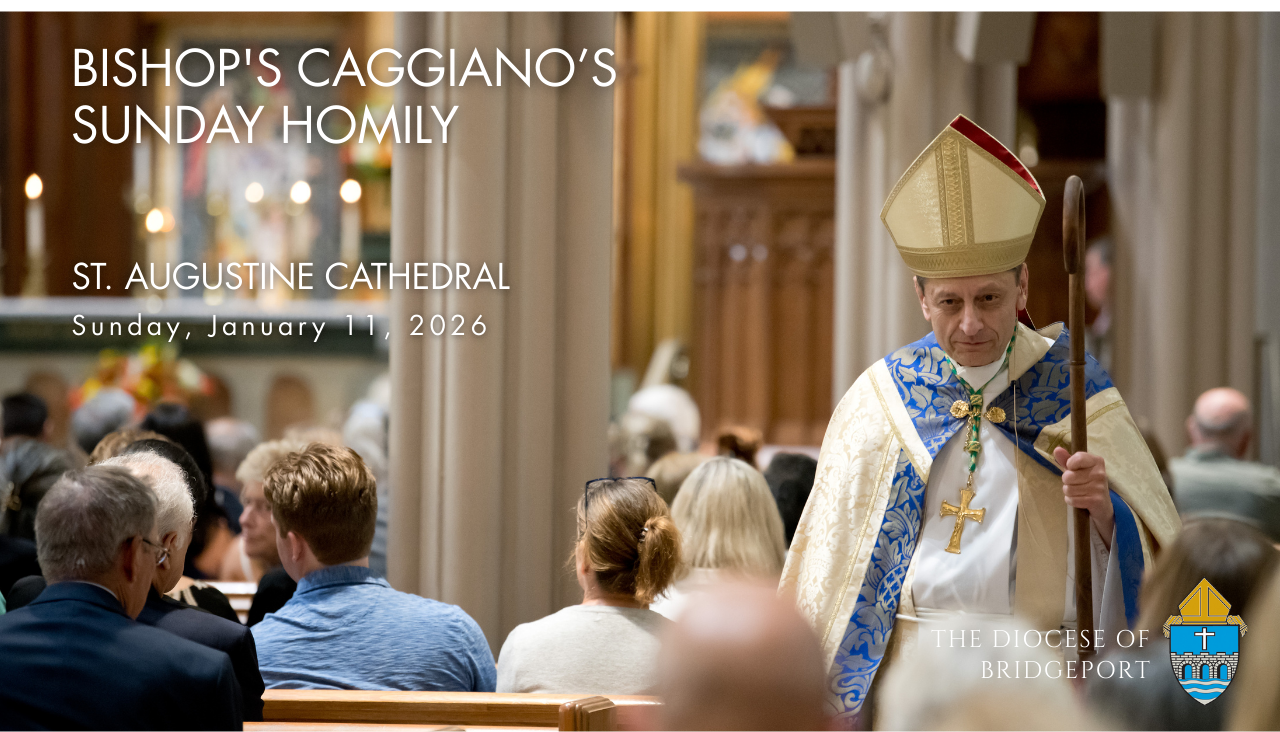
Sunday, January 11 @ 10:00 AM
St. Augustine Cathedral
So, my dear friends,
Today, as we celebrate the last day of the Christmas season, the Church, as she always does, places before us another story of the great epiphanies that occurred in the Lord’s life. Epiphany means a moment of revelation, a moment when the Lord gradually begins to reveal who He is—who this Child born in Bethlehem truly is.
As we heard last week, the coming of the Magi revealed that this Child has come for all people, Jew and Gentile alike. Today, we hear that He is the One who comes into the waters to bless them, so that they may become the means by which you and I receive what He offers: the gift of forgiveness and salvation.
And of course, next week, we will hear—as we always do—the story of Cana, where He begins to show why He came, and more importantly, how He will give us that gift of salvation: by changing water into wine, so that on the night before He died, He would take wine and transform it into His Sacred Blood.
But it is sobering to consider, my friends, that when all of those great epiphanies occurred, most of the world missed them.
The Magi came, and only the shepherds and animals joined them in adoration. The rest of the world was sleeping. Today, in the baptism, I am sure the vast majority of people at the Jordan said, “Look at that Jesus—that prophet. He’s no different a sinner than we are, coming to John to ask forgiveness of His sins,” when in fact He was the sinless Lamb of God.
And then at Cana, of course, all the guests must have thought, “Wow, this bride and groom are smarter than they look, leaving the best wine for last,” never imagining that it was God’s gracious gift to them—that He would, indeed, leave the best for last.
I mention this because we should not be hard on the people who had the privilege of living when Jesus walked this earth. Just as they missed the coming of the Lord—missed the moments of His revelation—so too do you and I miss Him every single day.
Jesus said at the end of His ministry, “I will be with you always, until the end of the ages.” My friends, what does that mean? It means always. It means every day, every moment of every day.
It means every circumstance, every possible place and condition—in our minds, in our hearts, in our wills. The Lord is always with us.
So my question to you is this: as we prepare to enter what we call Ordinary Time, how often do you and I miss Him?
You may be saying to yourself, “Well, Bishop, what kind of faculty, what kind of skill do I need so that I no longer miss Him?” The truth is, there is no special faculty, no special power required to recognize the Lord’s presence in our lives.
The Lord comes in the inspirations we receive while driving that bring us consolation. He comes in the beauty of a sunset, speaking to us of His power and grace as Creator. He comes in the words of a nurse who consoles us while we undergo chemotherapy, offering kindness and peace.
The Lord reveals Himself—and the list goes on and on. It is in the smile of a child. It is in the birth of a newborn infant. It is in the power of what two people can do together with God’s grace.
We see it in the moment of absolution when we come to confession and hear the Lord say, “Your sins are forgiven forever.” Great moments. Ordinary moments. The Lord is always manifesting Himself.
My friends, in order to begin no longer to miss Him, we must start questioning what the world tells us. You have often heard me say it, and I will say it again: the world describes as chance, fortune, and good luck what is in fact the grace and power of God at work in our lives.
The world wants us to believe that what is truly extraordinary is merely ordinary. Yet every breath, every day, every sunrise, every piece of music, every work of art, every poem—even the words you and I whisper to those we love—He is manifesting Himself everywhere.
The great challenge of this day is not to repeat the mistake of those who took it all for granted and simply kept going. You and I must do differently.
Allow me to suggest that in the weeks ahead, during Ordinary Time, we make it our business—our spiritual exercise, perhaps even a nightly reflection before bed—to ask:
“Lord, where did I see You today?
Where did I miss You?
Teach me to see You more clearly tomorrow.”
If we do this, I believe we will develop ever more grateful hearts. For we will no longer see the Lord only as the One who enters our lives in moments of crisis or trouble. Instead, we will recognize Him as the gentle Shepherd, the Lord of the nations, the One who brings salvation, the One who gives us His Sacred Body, Blood, Soul, and Divinity—walking with us in every moment of our lives.
For so great a gift, we can be nothing other than grateful each and every day.
In just a few moments, my friends, I will induct ten individuals into the Sacred Heart Guild. They have dedicated themselves to the work of beauty, reminding you and me that in every moment we experience beauty—and in the means by which beauty comes to us—Christ is revealing Himself. It is an epiphany.
I ask that you pray for them as they begin this work, so that through their guidance and example, we may learn anew to recognize the epiphanies placed before us.
My friends, the Lord is always walking with us.
Let us pray that we may see Him, and always remember that in life, we never walk alone.