By Kathy-Ann Gobin
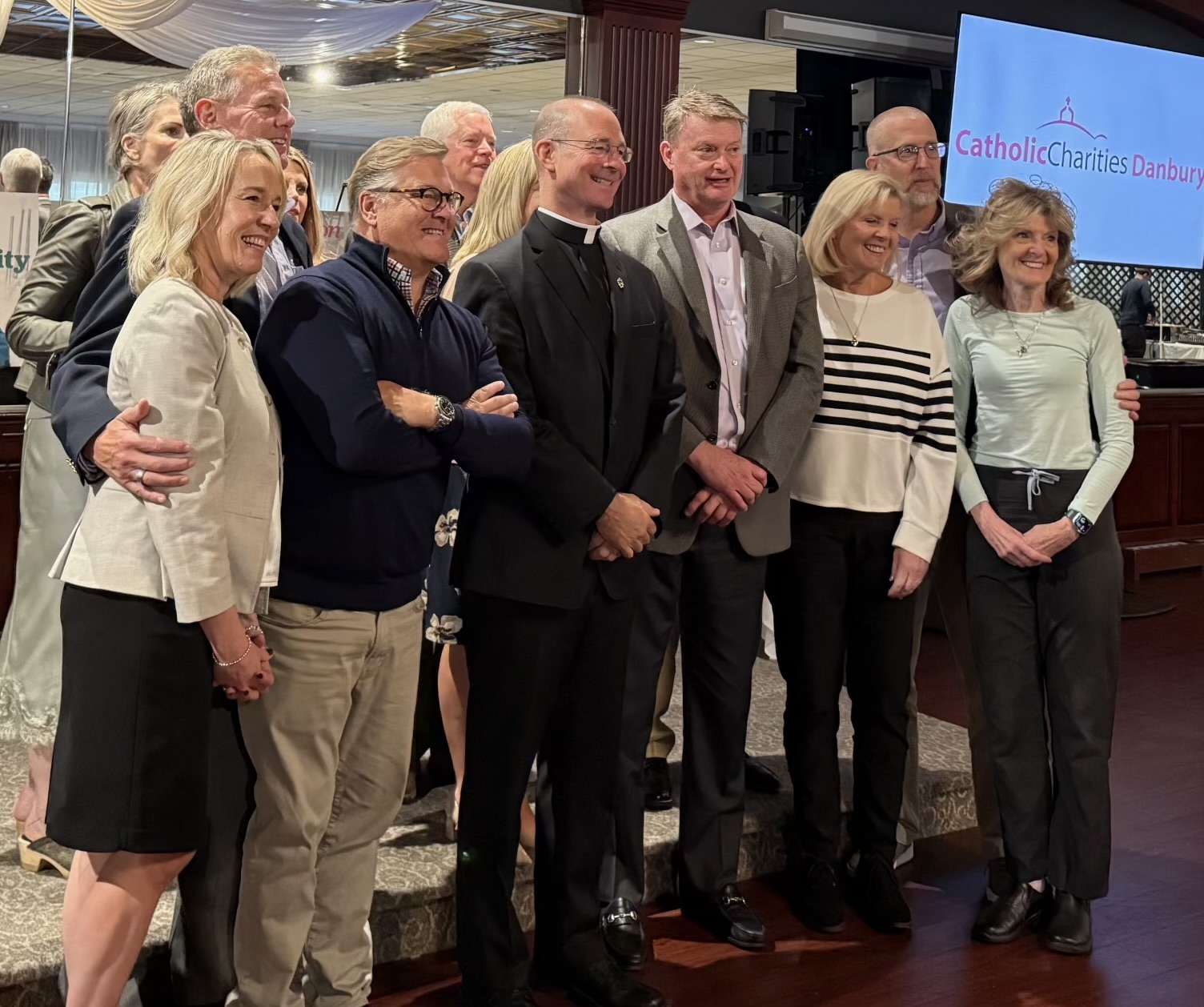
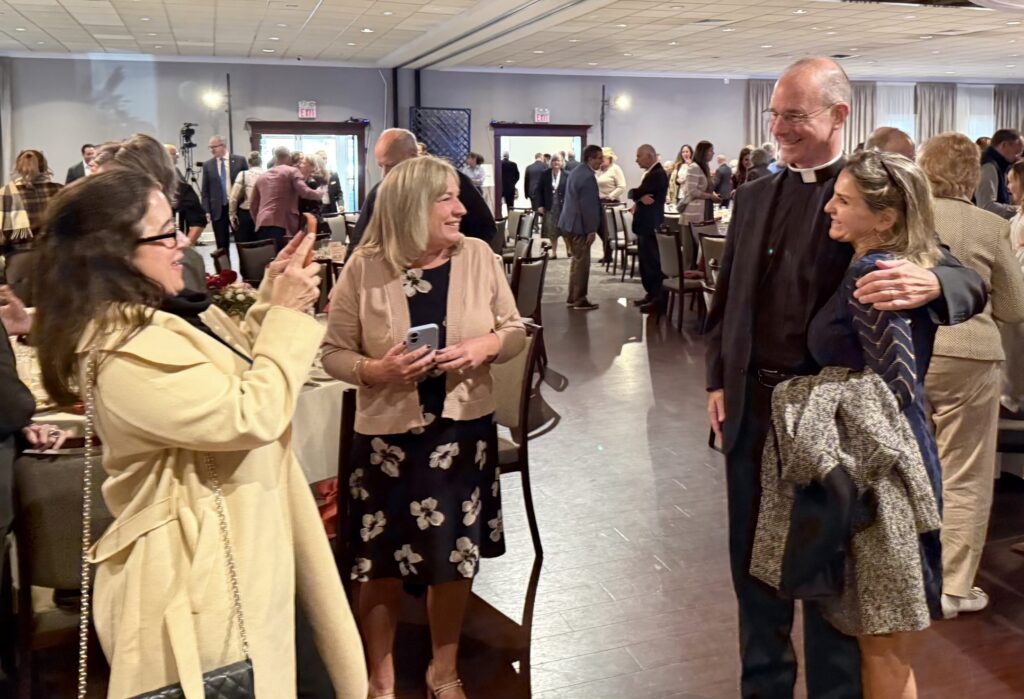
DANBURY – Living the three classic principles of the social doctrine of the Church — human dignity, solidarity and subsidiarity — was the message of Monsignor Thomas Powers, Rector of the Pontifical North American College, at the Catholic Charities’ annual breakfast fundraiser.
“These principles help us to be attentive to the needs of individual persons and not just humanity in general,” Msgr. Powers told the packed room at the Amber Room Colonnade in Danbury, which included family and friends from parishes throughout the Diocese of Bridgeport, where the Newtown native previously served as Vicar General and moderator of the Curia, as well as pastor of St. John Parish in Darien.
Msgr. Powers said Catholic Charities exemplifies the principles of social doctrine with the work they do every day through community support programs and services, such as offering warm breakfasts to people in need, loan and financial education, counseling, and immigration services.
He explained that acts of mercy recognize human dignity in individuals and said that the Apostolic Penitentiary office, which focuses on the forgiveness of sins, never closes even when all other offices in the Vatican come to a halt when a new pope is being elected.
“The Church never stops the work of the forgiveness of sins, even when there is no pope,” Msgr. Powers said.
Showing mercy to each other, he said, is acting God-like by giving the other person space and freedom to arrange his or her life anew and to start over again, just as God does for individuals who repent.
“We live in what is being called a cancel culture, but we need to remember that Jesus never cancels anyone. The only thing Jesus does cancel, is our sins,” he said.
“Mercy does not negate the need for justice. Rather it goes beyond justice,” he said. “Mercy is love to someone in need, maybe someone in my debt, but someone whose dignity I recognize nonetheless. If you want to treat others with human dignity, as Catholic Charities does, a good place to start is with mercy. One person at a time.”
Msgr. Powers spoke of solidarity and how the mosaics at St. Peter’s Basilica in Rome, look like paintings.
The mosaics are made up of thousands of little pieces of colored tiles, some as small as pebbles and carefully placed together to form one coherent image and each little piece has a unique place and purpose, he said.
“The principle of solidarity recognizes that everyone’s existence is deeply tied to that of others,” Msgr. Powers said. “Solidarity is a virtue that calls each one of us to seek the good of our neighbor with the readiness of the gospel to give of oneself, for the sake of another. Whatever our national, racial, ethnic, economic, and political differences, we are one human family, and we share one God, one Father, in Heaven.”
“If we want to promote solidarity, a good place to start, maybe to see myself as a small piece of a larger mosaic created by God. No better or worse, no more or less important than the others and to treat the other unique pieces around me as my brothers and sisters, one person at a time,” he said.
Explaining subsidiarity, Msgr. Powers said human affairs are best handled by the smallest group or unity, and larger entities should only provide support in case of need, and this way, decisions are made at the closest level possible to the persons involved.
“This is an important concept in Catholic social teaching, because every person, family and group has something original to offer to their own community, and to the larger community,” Msgr. Powers said.
“Each one of us is called to serve others and to be instruments of the Lord’s goodness, and Catholic Charities does that immensely well,” said Msgr. Powers, as he encouraged the audience to live out the principles of social justice to love, not humanity, but individuals as a brother or sister in Christ.
“We must always begin anew, and let old habits and practices die hard, and try once again, or maybe in a new way, to live the way to which God is calling us, and to be generous, so that we may, with God’s grace, and the prayers of Our Lady, make the world a better place, one person at a time,” Msgr. Powers said.
Catholic Charities is looking to do just that and is in the process of preparing to build a new facility on Main Street to house its services.
Renderings of a proposed new Danbury Family Center were in front of the room. The four-story building, which would be located on the south end of Main Street, would house Catholic Charity services and would have two floors dedicated to affordable housing.
Director of Catholic Charities, Danbury, Heather Ely, said the story of the Good Samaritan, where he renders aid to a person in need without first ascertaining who or where they are from, is a good example to follow.
“The Samaritan didn’t just feel badly for that person, he took action. To me, that’s what Catholic Charities is all about. It’s about being the Samaritan in people’s lives,” she said.
Sometimes issues of homelessness, and poverty, and immigration, and mental health challenges seem so complicated people forget that behind every story are human beings.
“At Catholic Charities, our job is to see the person behind that story. And to ask, one very simple question, ‘How can we help?’” Ely said.
She said the Morning Glory breakfast program at Catholic Charities is not just about addressing food insecurity.
“Our team sees it as an opportunity to offer dignity, and kindness, and compassion, and hopefully, to connect someone with the services that might change their path moving forward,” Ely said.
Catholic Charities provides many services that focus on getting people connected to resources.
“We’re here to give people the tools and support and resources so they can help themselves,” said Ely, adding that immigration services have been expanded to the Danbury region.
“Immigration is complicated. People have so many opinions right now about our borders, and our policies, and how our systems work. But I would like to believe that, regardless of your beliefs, everyone in this room would agree that people need to be treated with dignity and compassion and kindness,” Ely said.
“Our immigration program’s role is to provide affordable, qualified guidance, and to make sure that the people who come to us, not only know their rights, but they know their responsibilities, and what their path looks like going forward,” Ely said. “We want to make sure that they’re getting that advice from someplace they can trust.”
“The story of the Good Samaritan is that he didn’t solve every problem in the world. He simply helped the one person in front of him. That’s what we do every day. It’s one person or one family, one opportunity to make a difference.”