
By Joe Pisani
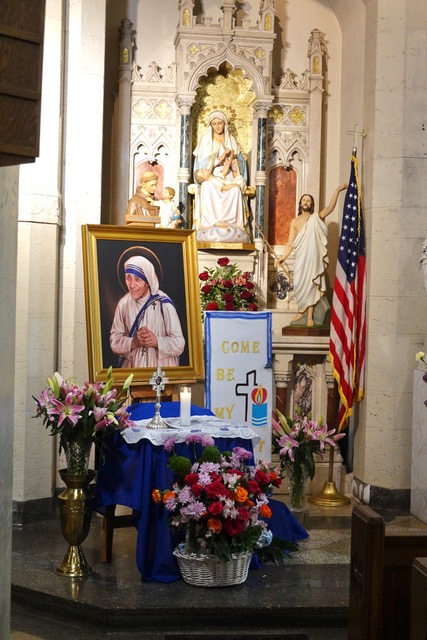
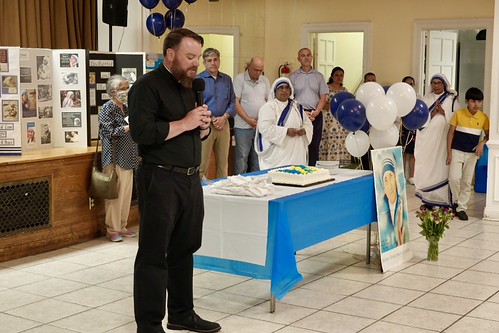
Ten years ago, Mother Teresa, who was revered worldwide as the Saint of the Gutters, was canonized by Pope Francis. On September 5, faithful from throughout the diocese, Catholic and non-Catholic alike, gathered to celebrate her feast day, filling the pews of St. Peter Church with song and prayer.
Members of the Missionaries of Charity in Bridgeport welcomed friends, well-wishers, religious sisters, lay Missionaries and volunteers to a Mass celebrated by Father Sam Kachuba, Episcopal Vicar for Young Adult Ministries, and Father Alexis Moronta, pastor of St. Peter’s.
“Today we celebrate this great saint of our own time,” Father Kachuba said. “We celebrate the saint who showed us in the flesh what it looks like to live out the Gospel imperative to serve those who are most in need, whether we recognize it is Jesus or not. We see in Saint Teresa of Calcutta one who taught us what it looks like to see Jesus, thirsty, naked, imprisoned, alone, abandoned, in need, and we’re reminded that we have the capacity also to see our Lord in that distressing disguise. We have the capacity to serve him in that need. We have the capacity to minister to him wherever we might find him, in whatever country we are, however we might live our lives, whatever might be going on. Each and every one of us.”
When St. Teresa of Calcutta died on September 5, 1997 at 87, she was beloved throughout the world by people of all faiths. A Nobel Prize laureate, she was known for her work with the poorest of the poor in India and for founding the Missionaries of Charity 76 years ago.
Sister Fabiana MC, who met Mother on several occasions said: “Jesus was Mother’s life. She served the poor, but Jesus was Mother’s life. She met the rich, but Jesus was Mother’s life. She traveled all over the world, but Jesus was Mother’s life.”
In his homily, Father Kachuba reflected on the great saint’s life and recounted his experiences working with the Missionaries of Charity in Madrid.
“Jesus teaches us that whenever we see someone, we’re meant to see in them the presence of Christ,” he said. “That one who is in need of love and mercy. When we see the poor, the sick, the lonely, the abandoned, the imprisoned, the naked — whoever it is that we see in any kind of need — it is Christ in his distressing disguise. This is precisely what Mother Teresa of Calcutta saw everywhere: Jesus in the distressing disguise of the poor.”
He said she established her community to embody the principles of loving trust in God, total surrender and cheerfulness born of faith.
Father recounted several stories about the summer he spent as a seminarian with the Missionaries in Madrid, where he was committed to “do whatever task the sisters gave me.” On one occasion, they said, “All right, Sam, we need you to wash the windows.”
He admitted that since childhood, washing windows was his most disliked chore; however, in pursuit of “total surrender,” he willingly climbed the ladder to the hot roof even though they told him he didn’t have to clean those particular windows, which overlooked the sisters’ private chapel.
When he looked in, he saw a sister kneeling in prayer and decided to come back later, and yet each time he returned, she was still there, and he was reluctant to cause a disturbance. Finally, he thought, “This is ridiculous; no one prays that much.”
“As I looked in the window, she didn’t move,” he recalled. “I was so profoundly touched by how focused she could be in prayer. I thought only someone who is totally surrendering to the Lord can have that kind of focus. How powerful!”
He spent the day thinking about her prayerful witness, and that evening, the sisters invited him into their chapel for vespers, and he made a startling discovery: “I walked into the chapel, and there to my right was a full-color statue of Mother Teresa, kneeling in prayer. And that’s what I had been looking at.”
Throughout the summer, he saw other examples of the sisters’ loving trust in God, total surrender and cheerfulness born of their faith.
“Saint Teresa invites us with that loving trust, that total surrender and that cheerfulness of life to see Jesus, to serve him, to love him more,” he said. “And in seeing him, serving him and loving him to transform, to elevate our whole humanity … and as we transform the world with his grace, with his goodness, with his Gospel, we find our own hearts transformed and changed.”
Today, the Missionaries of Charity have 754 homes in 138 countries and more than 5000 religious sisters serving the poorest of the poor.