By Andrew McAleer
All of us have been injured or abused in our lives. In the Christian ideal, we are taught to turn the other cheek. But it is hard to forgive a transgression. Far easier is it to wallow in our victimhood, to feel sorry for ourselves. Since this tends to be the case for even small hurts, what would we do were we to incur something terrible, even unthinkable? Could we live up to our Lord’s instruction, to forgive as many as seventy times seven?
Jennifer Hubbard experienced just such a horror on December 14, 2012 when her 6-year-old daughter, Catherine Violet, was killed in the Sandy Hook school shooting. At the time she was a stay-at-home mom. Previously she had been a corporate executive. In the aftermath of the tragedy, Jennifer channeled her grief into a deeper spirituality and avocation.
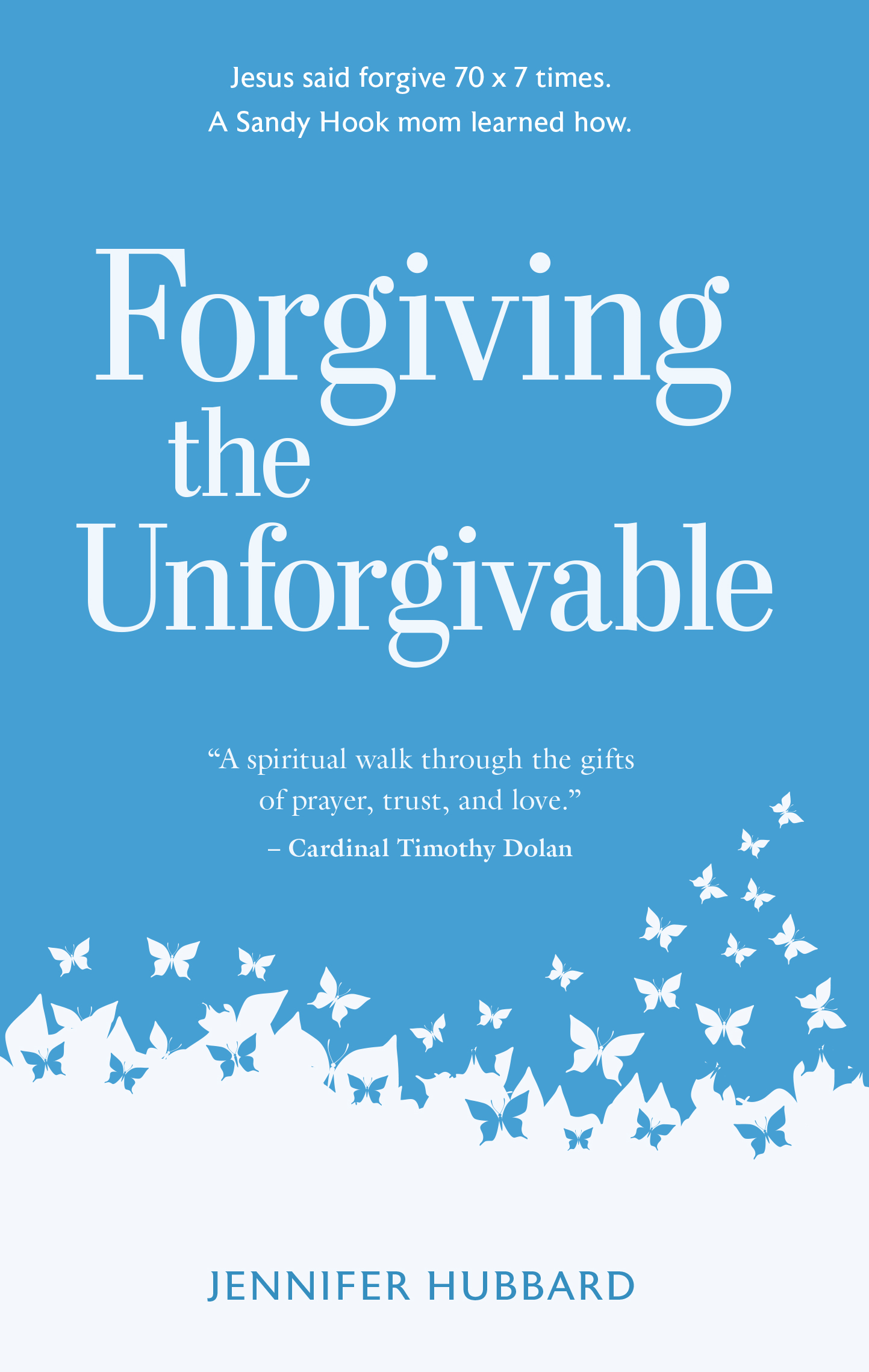
Her writings appear in Magnificat, and she lectures frequently to Catholic audiences. In the hundreds of talks she has given, one question is invariably asked: “Have you forgiven the shooter?” Instinctively, she answers, “Yes.” It is a true yes, not merely the proper, Christian thing to say. Then one day, after a decade of speaking engagements, the person who asked the question approached her privately and posed a follow-up question. It was in the form of a single word: “How?” The question haunted Jennifer and gave rise to a new book, her second, “Forgiving the Unforgivable,” published by the Marian Press.
This is a deeply personal book, as was Jennifer’s first, “Finding Sanctuary,” which recounted the heartbreak of her daughter’s death and the establishment of an animal sanctuary in her memory. Jennifer knows no other way to write. In both books, she addresses the reader as “my dear friend.” This comes when she makes a particularly important point, wanting the reader to pay close attention and also appreciate how much she cares.
This is not a self-help manual, for, as Jennifer explains, “forgiveness isn’t a transaction; it’s a transformation.” Further, “It’s about choosing to live free, even when the world would tell us we have every right to cling to the pain.” Clinging to the pain and resenting whoever has harmed us is our natural inclination. But Jennifer explains that when we remain in this state, we fail to “make room for the healing He longs to give us.”
She means this for every damage we experience, great or small. In her words, “There is no hierarchy for broken hearts.” Indeed, she chides the reader: “Please don’t size up your suffering to mine. Please don’t minimize the hurt that you experienced. Our wounds may look different, but pain is pain.” Heady words, when considering that the writer has indeed experienced the unthinkable, the ‘unforgiveable.’
Readers familiar with Jennifer’s work know that she has a talent for turning a memorable phrase. For instance: “Our suffering is where Heaven is given an opportunity to intersect earth.”
More than memorable phrases, Jennifer’s book painstakingly shares a path toward understanding the importance of forgiveness and its process. It is necessary, she reasons, because “When we don’t forgive, the pain doesn’t just stay—it grows roots.” Forgiveness is undertaken, “not to erase the pain but to free the space being claimed in my heart.” Further, “Forgiveness is the sacred surrender of the debt we believe we are owed.” This is not an easy undertaking. “Surrender is not weakness,” she writes, “It is warfare.”
In the book’s important Afterword, Bishop Frank J. Caggiano imparts, “Forgiveness is not merely one option among many in the Christian life. It is the very heart of our faith—the path we are called to take if we are to follow Christ.” Echoing Jennifer’s central theme, he reasons that forgiveness “begins with full acknowledgement of the hurt but refuses to let it have the last word…it is not naivety; it is love in action. It declares that evil will not have the last word.”
The last word here belongs to Jennifer, who warmly beckons the reader in her introduction, “…come sit with me awhile. I can assure you that this journey may begin in a place of brokenness, but ends in a sunrise of peace.” Take her up on her invitation.
(“Forgiving the Unforgivable,” which is due for publication on October 1, is available for pre-order on Amazon and at Marian Press.)