By Maricarmen Godoy
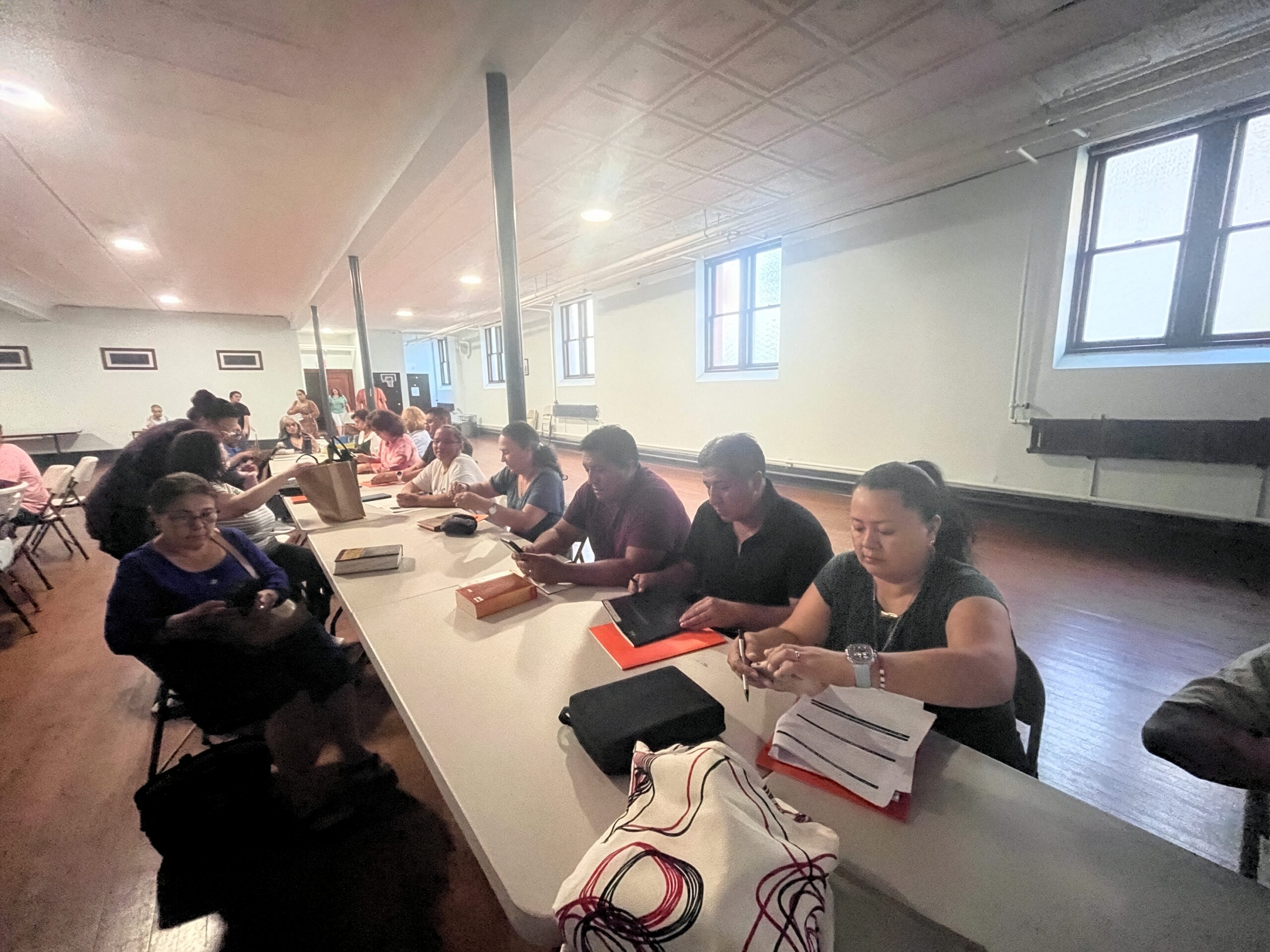
BRIDGEPORT-The Office of Hispanic Ministries of the Diocese of Bridgeport offered, over four consecutive Mondays, a formation program for members of Hispanic parishes who serve voluntarily as extraordinary ministers of Holy Communion. They received spiritual, liturgical and practical formation to carry out this ministry with reverence, humility and fidelity, in accordance with the norms and principles of the Catholic Church and as directed by the Diocese of Bridgeport.
According to Deacon Edward Carrillo, the course instructor, the training recalled “that the extraordinary ministry of Holy Communion is, above all, a service of love to Jesus and to his people, and those who receive this call through discernment act as servants who collaborate so that the Eucharist may be distributed in a dignified, orderly and reverent manner.”
“Communion flows from the sacrifice of Christ, made present in the Holy Mass. The extraordinary minister does not act as the owner of the Sacrament, but as a servant of a mystery that belongs to the Church.” This was one of the central messages shared during the formation, Carrillo said.
During the sessions, it was highlighted that the extraordinary minister must live this service from prayer and humility. The mission is not to seek recognition but to help each faithful person encounter Christ in the Eucharist.
Recalling the words of Saint John the Baptist: “He must increase, and I must decrease,” Carrillo said, “The extraordinary minister does not appear in order to stand out or excel; he appears to serve.” He also recalled that no one appoints himself to this ministry; rather, the Church establishes a process of discernment and specific requirements before granting this pastoral service.
Among the requirements are being a practicing Catholic; having received the sacraments of Christian initiation — Baptism, Confirmation, and Eucharist; maintaining a life consistent with the faith; having a good moral reputation; and completing the formation required by the Diocese, including the Safe Environment program and Virtus training. “The desire to help is important, but in the Church it is not enough simply to want to serve. There is a call and a suitability that must be discerned,” Carrillo said.
For that reason, in simple terms, Maury Puello, a Colombian who has served for 15 years at Saint Peter Parish in Bridgeport, said that the Extraordinary Ministers of Communion learned that the minister’s service begins before approaching the altar. “Preparation includes personal prayer, arriving early, reviewing the service assignment, communicating with the coordinator and knowing whether they will distribute the Body of Christ or [the Precious Blood],” she said.
The formation also emphasized the importance of personal presentation as a sign of respect toward the Eucharist. Ministers should dress in a clean, modest and appropriate manner, avoiding anything that could distract from the solemnity of the celebration, as well as the importance of purifying, or cleaning, the hands as a gesture of reverence before and after carrying out the ministry.
“The question is not only how we perform a task, but how we present ourselves before the Lord. We serve a mystery that we do not fully understand but that we receive with faith,” Carrillo shared as a reflection during the training.
This led Carolina Maldonado, a native of Guatemala with 15 years serving as an extraordinary minister of the Eucharist at Saint George Parish, to recount how a child — who had not yet made his First Communion — received Communion. Thinking it was a tasteless cookie, he threw it on the floor and stepped on it. Filled with pain and sadness, before proceeding to purify the place where the Body of Christ had fallen, she shared guidance with the parents, and the priest later celebrated a Mass of Reparation for the offense.
Another aspect addressed during the course was how ministers must respect the formulas established by the Church. When giving the consecrated Host, they should limit themselves to saying only “The Body of Christ,” and when offering the chalice “The Blood of Christ.” The response of the faithful person receiving Communion should be “Amen,” as an expression of faith and acceptance of the sacrament received. This is based on a proper order that must be respected, without adding words, explanations, or personal gestures that could alter the rite.
During the formation, it was recalled that Holy Communion is not simply a moment within the Mass but the culmination of the Eucharistic sacrifice. “The Mass begins with the first entrance hymn and continues through the final recessional hymn. Everything is part of the celebration,” Carrillo explained, noting that extraordinary ministers must first receive Communion themselves and then serve Christ in others. “We do not give what we have not received. How can we give Christ if we ourselves have not received him with faith?” The ministry also includes the possibility of accompanying the sick and bringing them Holy Communion once the necessary authorization is obtained.
Originally from Mexico, Ignacio Andrade, who has belonged to Saint George Parish in Bridgeport for more than 20 years, asked Carrillo several questions. They included ones about how pastoral consistency with the rite and the spirituality that should prevail during the celebration of Mass can be understood, so as to approach the Eucharist with faith.
Meanwhile, Mildred Vela, originally from Guatemala and a member of Saint Peter Parish in Bridgeport, spoke about the need to use words correctly. “One should not say ‘clean’ but ‘purify,’ and this difference is important because we are speaking from a world of spirituality and connection with Christ,” said Vela, who has lived in the United States for 29 years and has served as an extraordinary minister of Holy Communion for 13. She also noted the use of the word “minister” in the masculine even when referring to a woman.
The extraordinary minister of Holy Communion is called to be an instrument of unity, faith and love, helping each person who receives the Eucharist to approach Christ with reverence, respond with faith and return to daily life strengthened by the grace of God.