By Laura Brennan
REDDING — The priest wore black vestments.
The catafalque, with the appearance of an empty casket, was draped with a black cloth and was surrounded on either side, three on the left and three on the right, with unbleached brown candles.
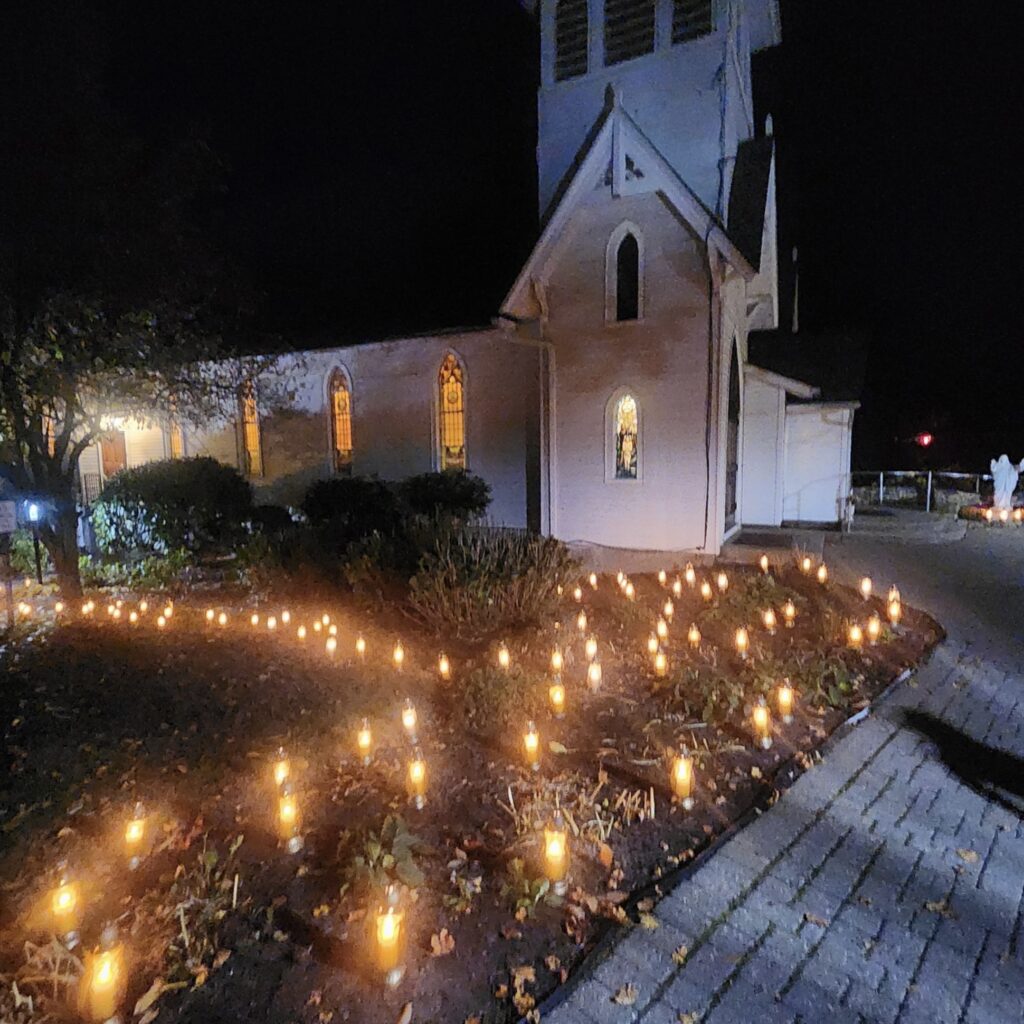
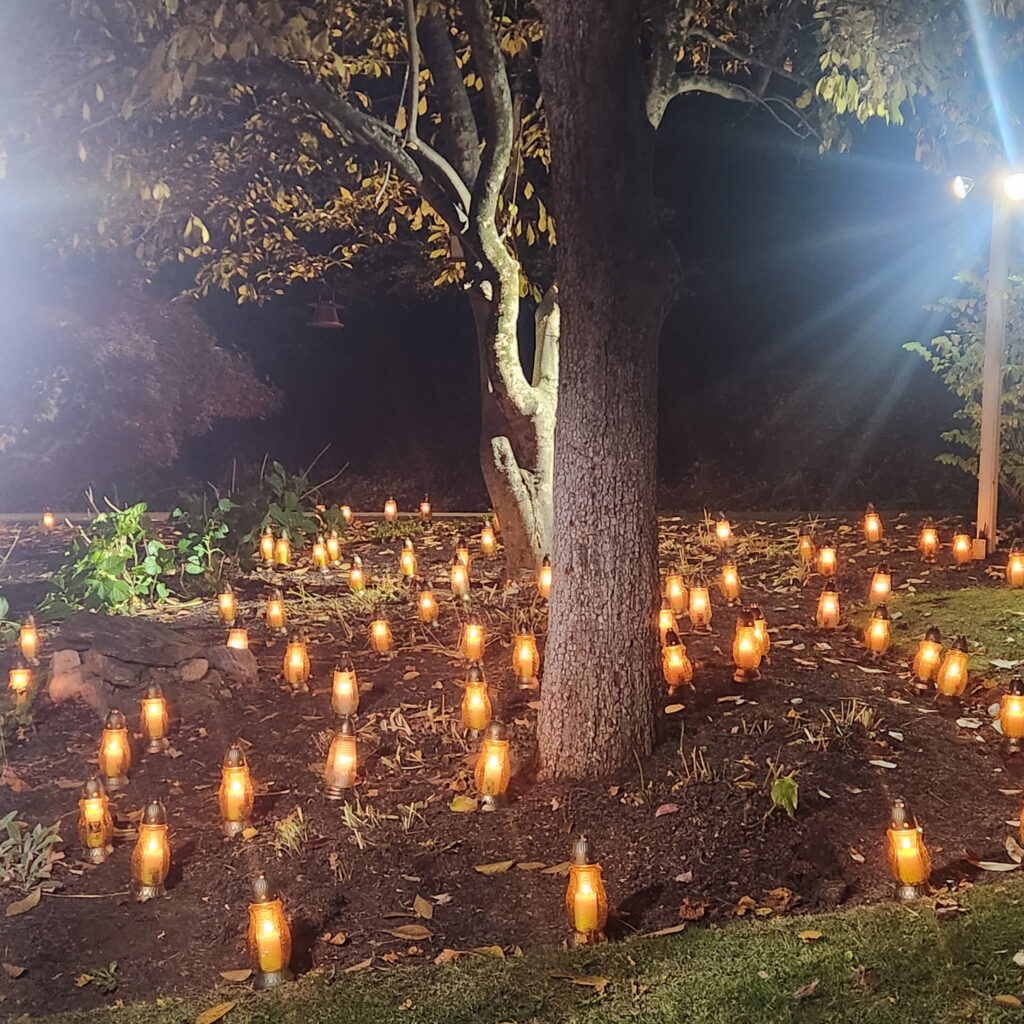
The entrance antiphon, Réquiem ætérnam, was chanted while the organ sat silent. Outside, 280 soul lights burned into the dark, still night, each in memory of a soul.
Some 80 faithful attended the evening All Souls Day Mass at the Georgetown Oratory of the Most Sacred Heart of Jesus in Redding, chanting along with the Latin words in their programs: “Réquiem ætérnam dona eis, Dómine: et lux perpétua lúceat eis. Ps. 64:2-3. Te decet hymnus, Deus, in Sion, et tibi reddétur votum in Jerúsalem: exáudi oratiónem meam, ad te omnis caro véniet. — Réquiem ætérnam…”
Or prayed silently along with the English translation: “Eternal rest grant unto them, O Lord; and may perpetual light shine upon them…. A hymn, O God, becometh Thee in Sion; and a vow shall be paid to Thee in Jerusalem: hear my prayer; all flesh shall come to Thee. — Eternal rest…”
Father Michael Novajosky, rector of the Oratory, offered the Requiem Mass in Latin, a tradition for All Souls Day. It is somber and takes death very seriously. It is a moment of recognition of death, of the need to pray for the deceased, and the truth of our mortality.
During his homily, Father Novajosky spoke of the importance of praying for the dead. He shared G.K. Chesterton’s concept that tradition is the democracy of the dead.
“Just because a person is no longer alive doesn’t mean that his or her voice should not still be heard,” he said. Tradition is the way that those who have gone before us continue to speak and offer their contributions. And so, we remember them and pray for them.
Programs with translations of the Latin prayers were available.
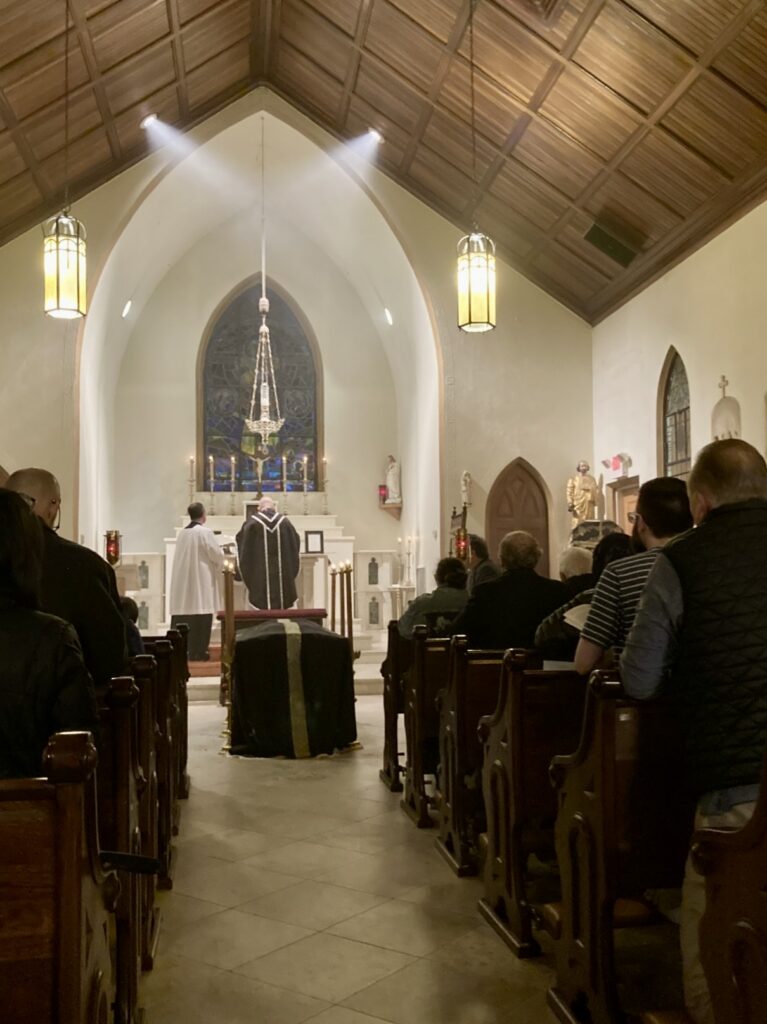
“If a person wishes, he or she can follow along,” said Father Novajosky, “while some people simply enter into the prayer.” As it becomes more familiar, people can offer the responses while others might pray a rosary.
“I encourage people to just pray,” he said, “however, it is you pray, however you pray when you’re alone, go ahead, just pray.”
The Mass also included the chanting of the Dies Irae, or Day of Wrath, a medieval poem that is omitted in the newer funeral Mass. “It brings in the reality that we have life, but at some point our lives are going to end. And, at some point, we’re going to meet the one who is the judge, but also the one who is the merciful one. ‘Pie Jesu Domine,’ or ‘pious and merciful Jesus,’” said Father Novajosky.
It was chanted, so only voice was heard.
Father Novajosky said it establishes that one day the Book of Life will be opened and everyone will stand before the Lord God. He said it is somber and beautiful.
“The Lord, you who absolved Mary Magdalene, remember us as well, and look upon us with that mercy,” he said.
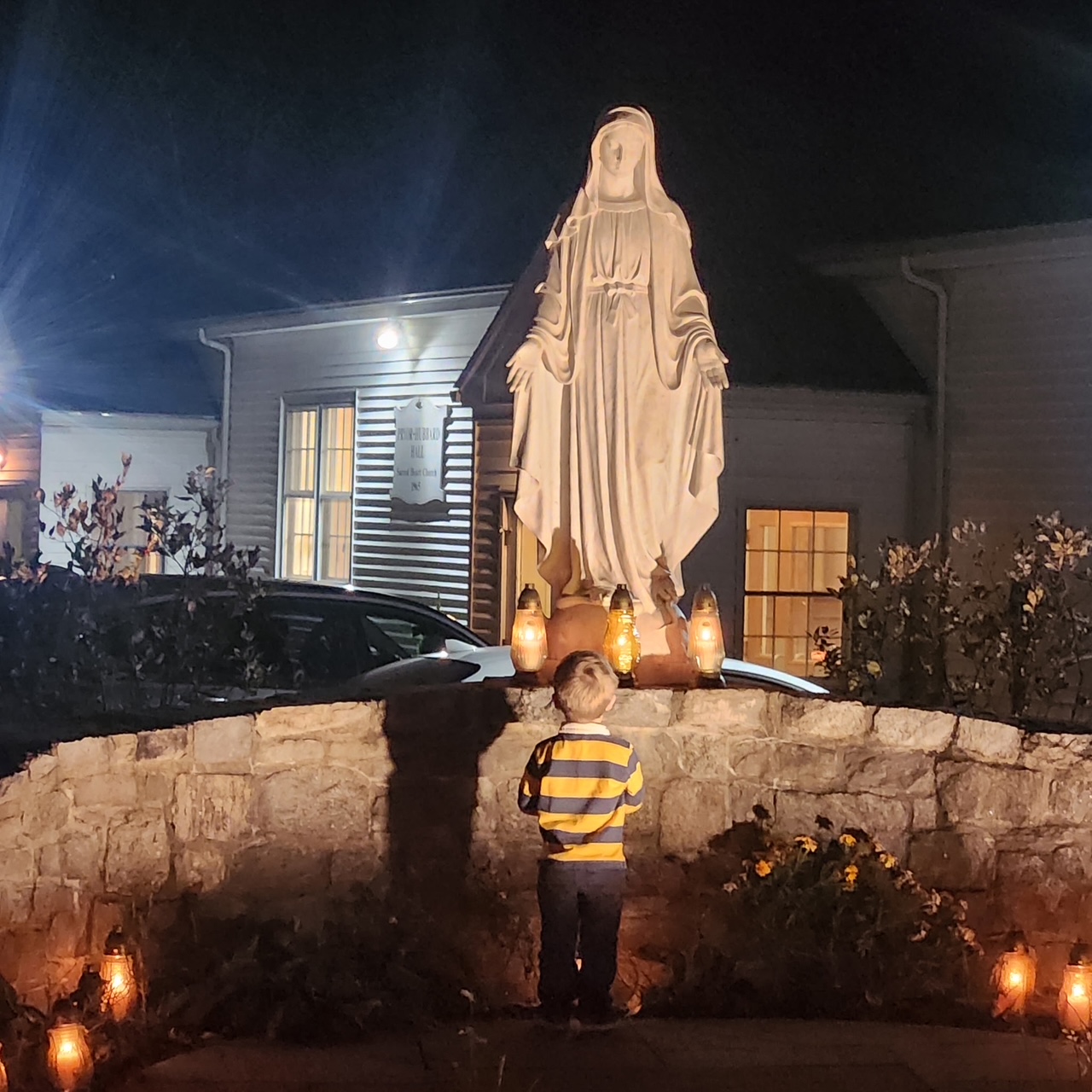
Following the Mass, the faithful processed down the path illuminated by soul lights, lanterns with candles, to the garden with the statue of Our Lady. There, Father Novajosky recited the Bede Roll. Children heard the names of grandparents they had never met. Many paused at the familiar names of loved ones.
Father Novajosky read the 280 names which had been submitted in the previous weeks. Each soul was represented by a burning flame, and name after name, those gathered offered each in prayer.
The evening concluded with the sweet tradition of the soul cake. Attendees gathered in the hall for social time with refreshments and these traditional treats. Some cakes were more like shortbread, some were decorated with simple crosses, and many included warm spices like cinnamon, clove or allspice.
Trick-or-treating is often traced back to this Catholic tradition, and it was known that accepting a soul cake is accepting a promise to pray for a departed soul.
Each soul light burns for 60 hours, lifting the offered prayers with its flame. In the dark hours for the next few days, cars passing 30 Church Street slowed or stopped at the sight. One by one, each burned out, and, as is tradition, their voices were heard through the prayers.