By Emily Clark
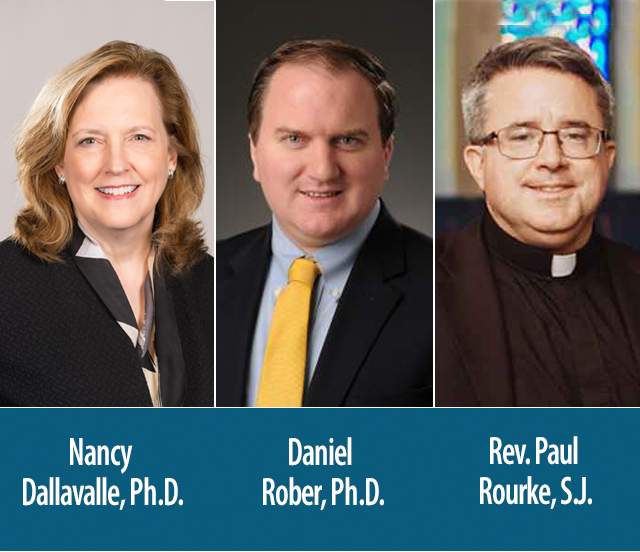
Following the release of Pope Leo XIV’s first encyclical, Magnifica Humanitas in May, faculty and administrators at Fairfield University and Sacred Heart University offered their expert commentary on this document, which addresses one of the major challenges facing humanity in the 21st century: artificial intelligence. These scholars include Nancy Dallavalle, Ph.D., associate professor of religious studies and director for the Center for Catholic Studies, and Rev. Paul Rourke, S.J., vice president, mission & ministry, from Fairfield and Daniel Rober, Ph.D., associate professor and chair of the department of Catholic Studies at Sacred Heart. Each responded to three questions in an interview with Fairfield County Catholic, providing an in-depth look at the encyclical and what Catholics can learn from it.
FCC: What were your first impressions of the encyclical and the pope’s concern about artificial intelligence?
Nancy Dallavalle: There is broad interest in Pope Leo’s engagement with technology, particularly that he is engaged directly with tech executives to produce such a text. It will be helpful for Catholics to realize that [his] concern is not about directing artificial intelligence technology but about safeguarding exactly what his subtitle says: the human person that is being challenged by technology not only in the abstract but by the way it has been employed in the situation of many social pressures. The church’s reach is global, and the Pope’s voice comes as a moral loadstone because he speaks in a way that no one else can. Catholics in the pews will receive this in an already charged environment in which many things are swirling around.
Fr. Rourke: It’s a beautiful synthesis, a wonderful summary of Catholic social teaching, a kind of short course. Leo doesn’t dance around some of the challenges we face as a human race in the 21st century. I think he’s calling us to take responsibility for our own destiny and to reappropriate our humanity so that we don’t accept that technology will dictate our future and we have no role in it. He’s really putting the human being, the human person front and center and inviting us to rediscover our own dignity and humanity.
Daniel Rober: I think the encyclical has been advertised as being about artificial intelligence and certainly a good chunk of it is, but it really gives us an overall view of Pope Leo’s priorities and the connections between them. The big issues that it fixates on are responding to AI and protecting the human in light of that, along with war and peace issues. There’s a very important section in the document where Leo talks about the kind of internal implications – for Catholic social teaching, for the church and of moving away from what he calls abuse of power and abuse of conscience. He says, “We must not wait for others to compel us to confront uncomfortable truths about ourselves.” Pope Leo is, in this encyclical especially, the public face of the church.
FCC: As faculty members or administrators, how do you think colleges should balance the educational benefits of AI with concerns about academic integrity?
Nancy Dallavalle: I want [students] to be able to recognize the dignity of the furniture already in their brains, to claim it and to say, “I am a thinking person encountering these ideas. Here is how I am going to process it” and not hand that tough work off to artificial intelligence. If you are 18 years old and encountering a lot of new ideas and have way too much reading, your gut impulse is to reach for [AI] because you have many other classes, et cetera, et cetera. Our job is to press, and Catholic colleges have been given a giant welcome mat from Pope Leo with this encyclical saying, please engage students so that they encounter themselves as intellectual, spiritual, moral, human beings. And we can because we have the mandate. That’s part of our mission.
Fr. Rourke: Put the experience first, and ask: what is really going to help our students flourish so they develop as human beings who are people of integrity? How do they develop so they can think and communicate and reflect on their experience as human beings? We need to be clear about that. We’d like our students to be well-prepared for the workforce and the marketplace, but the primary value is how do they come alive as human beings? How do they have meaningful lives and ultimately get to Heaven? So, that’s what we should ask ourselves. I do think that there’s a role for [AI] . . . but don’t sacrifice the ability to write and to think for the expediency because ultimately, when we sacrifice for expediency, we are becoming cogs in this machine. We’re not actually helping to preserve what is meaningful to be a human being.
Daniel Rober: Artificial intelligence has put college faculty and administrators in a difficult position as there is a lot of pressure to keep students up with what’s perceived to be the leading edge of skills they need to have in the workplace for AI training. Leo alludes to not only reading and writing but a kind of self-reflection and discernment that come out of those processes. You may be trained how to use AI in the workplace, but are you trained to use it as a human being or as somebody who is dispensable? Human beings are not dispensable; they’re not disposable. Pope Leo is an Augustinian, and Augustine is famous for thinking about these questions.
FCC: What ethical concerns about AI seem most urgent from a Catholic perspective?
Nancy Dallavalle: Ethically, the big question is that of human agency and of human authority. The question of how warfare will be conducted is one that involves issues of human agency, which is why Pope Leo says, the notion of a just war has to be really reengaged. There is also a tendency with the kind of power that AI represents to give ourselves over to authority, whether it’s the authority of the algorithm or the authority of the state, which presents itself as so overpowering. How do we look at the environmental impact? I think there’s a big question of human agency in an age where technological, social and political, Quasi-authoritarianism seem to be driving the show, and human care, the civilization of love and human solidarity seem like afterthoughts.
Fr. Rourke: In terms of the ethical concerns, ultimately, who gets to decide our future and how is that decided? I think that’s what Leo is getting at along with the fundamental question of who takes part? There are ethical considerations that go with that about human flourishing and dignity and the ability to provide for one’s livelihood. How do we safeguard those? Already we see how [AI is] taking a deciding role in warfare and apart from the ethical questions about whether there’s a just war or not, it seems to me that Catholic teaching really requires that human beings are the deciders about the use of lethal force, and that it shouldn’t be just a machine. Pope Leo puts a lot of emphasis in the document on the universal destination of human goods.
Daniel Rober: There’s a concern about detaching ourselves from the human experiences of reading, writing, creativity, art. Are we committed as a church to humanity and to human production? And what does that mean if we are or aren’t? What Leo talks about really applies to letting our lives be taken over by algorithms and automation, just letting ourselves kind of drift along and not develop the ability to step back and assess whether that’s the right thing or whether that’s leading us to good places. It’s that loss of control or human input. If our systems become more and more automated [due to AI], what does that say about questions in medicine, in social services? So many of these areas are dependent on the human touch, knowing a person face to face. The encyclical is a remarkable document showing where Leo’s priorities are. It’s not just addressed to us as Americans; it’s addressed to the whole church. It is quite important in terms of thinking about ourselves, not only in relation to external issues but in terms of how we live together as a society and as a church and build up our communities.